

In the last few years, “working from home” has evolved from a temporary necessity into a permanent lifestyle for millions of Americans. However, the biggest bottleneck for remote workers has always been connectivity. Stuttering Zoom calls, slow file uploads, and unreliable home Wi-Fi have plagued the digital workforce.

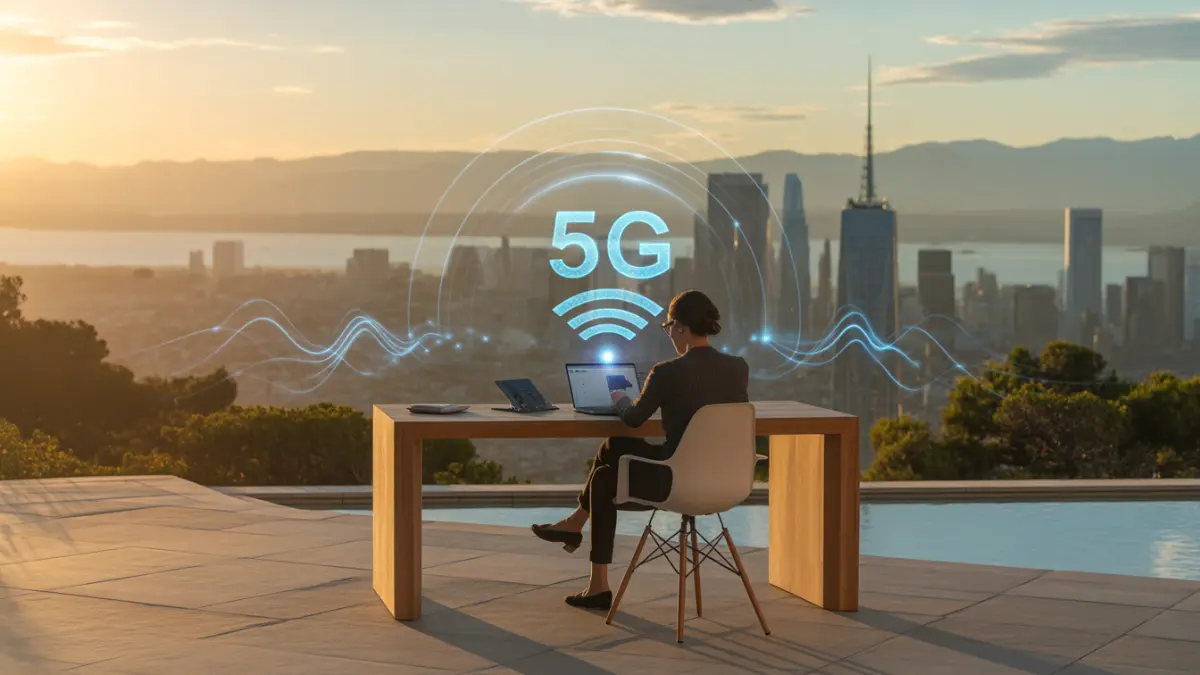
Enter 5G technology.
As of 2025, 5G is no longer just a buzzword; it is a critical infrastructure that is reshaping how business is done in the USA. From ultra-low latency to the rise of “Digital Nomads,” this article explores the tangible impact of 5G on the future of work.
What is 5G and Why Does It Matter for Work?
5G is the fifth generation of mobile network technology. It is designed to connect virtually everyone and everything together including machines, objects, and devices.
Unlike 4G, which was built mainly for smartphones, 5G is built for heavy-duty data.
- Speed: 5G can be up to 100 times faster than 4G.
- Capacity: It can handle millions of devices per square mile without slowing down.
- Latency: It reduces the “lag” time to mere milliseconds, making real-time collaboration possible.
1. The End of “Video Lag” in Conferencing
For most remote workers, the daily reality involves video conferences on platforms like Zoom, Microsoft Teams, or Google Meet. On older networks, these calls often suffer from freezing screens and audio delays.
With 5G, latency drops to 1-5 milliseconds (compared to 30-50ms on 4G). This near-zero lag means:
- Real-time interaction: Conversations flow naturally without talking over each other.
- High Definition: 4K video conferencing becomes standard, allowing for clearer presentations.
- Augmented Reality (AR) Meetings: Companies are now testing holographic meetings where remote colleagues appear as 3D avatars in the room, a feat only possible with 5G bandwidth.
2. Freedom for “Digital Nomads”
Before 5G, “working remotely” usually meant “working from your home Wi-Fi.” If you left your house, you were at the mercy of shaky coffee shop internet or weak mobile hotspots.
5G has liberated the workforce from the home office. Because 5G speeds often rival or exceed traditional fiber-optic cable speeds, workers can now:
- Work from Parks and Public Spaces: High-speed connection is available outdoors in major US cities.
- Travel While Working: The concept of the “Workation” has exploded. Professionals can upload massive video files or code from a hotel room or even a moving train without interruption.
- Rural Accessibility: 5G Fixed Wireless Access (FWA) is bringing high-speed internet to rural parts of America where laying cables was too expensive, opening up remote work jobs to people living outside major cities.
[Video Placeholder: Embed a relevant video here, e.g., “How 5G Works Explained”] (Note: To maintain your PageSpeed Score of 100, ensure you use a “Lazy Load” plugin or facade when inserting the video link here.)
3. Cloud Computing on Steroids
Modern businesses rely on the Cloud (Google Drive, AWS, Dropbox). However, accessing large files in the cloud used to feel slower than opening them from your hard drive.
5G changes this dynamic. With download speeds potentially reaching 10 Gigabits per second (Gbps), pulling a file from the cloud feels instant.
- Video Editors: Can edit 4K raw footage stored on a server in New York while sitting in Los Angeles.
- Architects: Can render massive 3D CAD models in real-time without needing a supercomputer on their desk.
4. Enhanced Security for Enterprise
Cybersecurity is a major concern for remote work. Public Wi-Fi networks (like at airports) are notoriously insecure and easy for hackers to snoop on.
5G networks offer a more secure alternative. Because 5G standards include stronger encryption and authentication protocols than previous generations (and certainly better than open Wi-Fi), many companies now encourage employees to use their 5G hotspots rather than public Wi-Fi when working externally. This “Network Slicing” capability allows telecom providers to create dedicated, secure slices of the network specifically for business data.
Conclusion
The rollout of 5G across the USA is not just making our phones faster; it is fundamentally changing the geography of work. It is removing the physical tether that bound employees to their desks, allowing for a truly mobile, efficient, and flexible workforce. As coverage expands in 2025, we can expect the line between “office” and “anywhere” to blur even further.
Read More- The Role of a Business Incubator: How They Support Early-Stage Startups
Frequently Asked Questions (FAQ)
Do I need a new phone or laptop to use 5G for work?
Yes, to access 5G network speeds, you need a 5G-enabled device (smartphone, tablet, or laptop) and a data plan that supports 5G from your carrier.
Is 5G internet available everywhere in the USA?
As of 2025, 5G has extensive coverage in most major cities and many suburban areas. Coverage in deep rural areas is improving through Fixed Wireless Access but may still be limited compared to urban centers. You should check carrier coverage maps for your specific location.
Is 5G secure enough for handling sensitive company data?
Generally, cellular networks like 5G are considered more secure than public, unsecured Wi-Fi hotspots. 5G has built-in security enhancements like improved encryption. However, for highly sensitive corporate data, companies should still use a VPN (Virtual Private Network) over any connection, including 5G.
Will 5G replace my home fiber or cable internet?
For many people, yes. 5G Home Internet (Fixed Wireless) is becoming a viable and often cheaper alternative to traditional cable broadband, offering competitive speeds sufficient for households with multiple remote workers and 4K streamers.